


Think Like an Architect: Design Beyond Pinterest
Get unlimited access to all learning content and premium assets Membership Pro
Architecture Fundamentals
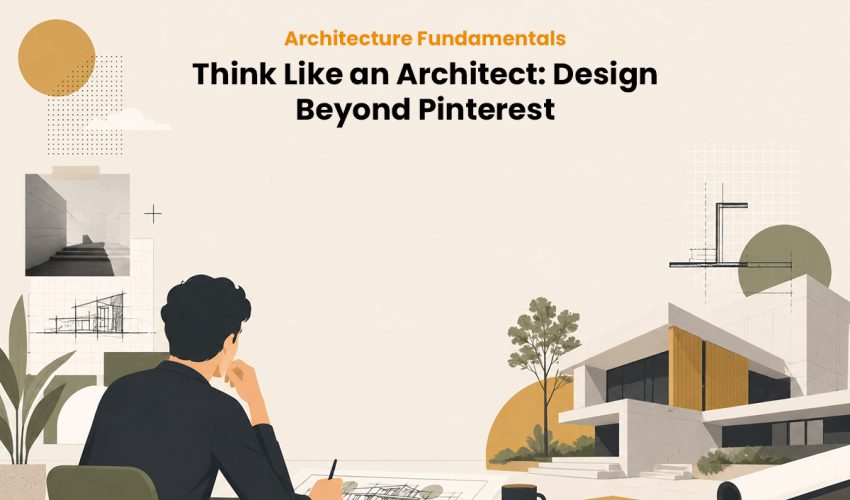
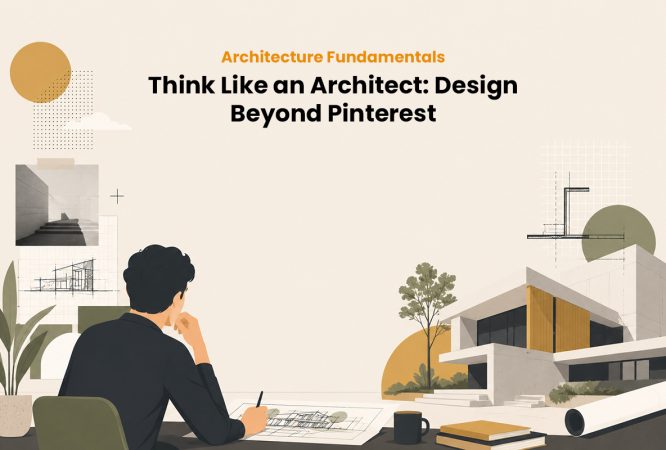
Think Like an Architect: Design Beyond Pinterest
Saved boards and mood images will never make you a designer. This course rebuilds how you actually see, read, and think about space — the way trained architects do, not the way algorithms curate.
| ▦6 Modules · 25 Lessons | ⏱Self-paced · Online | ⌗EN / ES |
Built For
Architecture students and early-career architects who design by instinct — and want to design by understanding.
If you’ve ever copied a layout because it “looked right” without knowing why, or struggled to explain your design decisions in a crit, this course exists for exactly that gap.
What You’ll Learn to See
Design thinking isn’t aesthetic preference. It’s a discipline.
This course rewires how you observe space, read context, and make design decisions — the foundational thinking every strong architect relies on, regardless of style.
01
◎
Reading space, not decorating it
How scale, proportion, and human behavior shape spatial experience — before a single material is chosen.
02
▤
Principles over trends
Light, rhythm, materiality, and color as functional tools — not finishing touches borrowed from a feed.
03
⌖
Context over copying
Why vernacular architecture and local identity outlast every trend cycle — and how to design with context, not against it.
04
❖
Concepts you can defend
Moving from moodboards to real design strategy — and presenting ideas with the reasoning to back them.
Why This Matters Now
Visual references have replaced design reasoning. That’s a problem juries and clients both notice.
Juries can tell the difference
A design with reasoning behind it survives a crit. A design copied from inspiration boards doesn’t — and panels notice immediately.
Clients ask “why,” not “what”
Architects who can explain the logic behind a decision close more projects than those who can only show references.
AI has made imagery free
Anyone can generate a beautiful render in seconds now. Design thinking — not imagery — is what remains genuinely valuable.
Trends expire. Principles don’t
Students fluent in design principles can adapt across styles and decades. Trend-followers have to restart every cycle.
Course Structure
6 modules. 25 lessons. One way of thinking.
Rethinking Design Mindsets
Locked
Understanding Space
Locked
Design Principles That Matter
Locked
Thinking Beyond Trends
Locked
Visual Communication & Concept Development
Locked
Real-World Architectural Thinking
Locked
Full lesson-level breakdown unlocks inside the course.
Stop designing from references. Start designing from reasoning.
Available now · English & Spanish
Common Mistakes
The habits that quietly stall design growth.
Collecting references feels like progress, but it substitutes someone else’s decisions for your own design thinking.
Aesthetics-first thinking produces spaces that photograph well but fail the people who actually use them.
Trend-driven design ages badly and reads as derivative the moment the trend passes — usually within a year or two.
“It looked nice” doesn’t survive a jury, a client meeting, or a competitive portfolio review.
These habits don’t just slow design growth — they show up in every crit, every client pitch, and every portfolio review until they’re corrected at the root.
What You’ll Walk Away With
Not a style. A way of thinking.
Every lesson builds toward one outcome: design decisions you can explain, defend, and repeat — in any studio, for any client, anywhere in the world.
Spot what works and what fails — and articulate exactly why.
Move from blank page to defensible design idea, consistently.
Speak about your work with reasoning, not just adjectives.
Design thinking that holds up regardless of where styles move next.
From vernacular to parametric — the thinking underneath stays the same.
Why Rethinking The Future
Built by people who’ve reviewed thousands of student portfolios.
RTF has spent over a decade looking at architectural work from every corner of the world — through our awards, publications, and global community. This course is built on what consistently separates strong design thinking from surface-level imitation.
Global, not regional
Built for architects and students anywhere — not one school’s curriculum or one country’s codes.
Taught by practice, not theory alone
Every principle is grounded in how real juries, clients, and critics actually evaluate design work.
English & Spanish
Full course access in both languages — built for a genuinely international student and practitioner base.
Sequenced, not scattered
Six modules building in order — not a random collection of design tips and Pinterest-style inspiration.
Who This Course Is For
If you recognize yourself here, this is built for you.
Strong references, weak reasoning
Your boards look good. Your crits don’t go as well. You want the thinking that makes both match.
Ready to design with intention
You’re past the basics and want to design from principle, not habit — and explain why to clients who ask.
Entering design from elsewhere
You’re moving into architecture or design from another field and need the foundational thinking, fast.
Skilled but missing the framework
You’ve picked up tools and software, but no one ever taught you how architects actually think.
From the Community
What changes when design becomes reasoning.
“
I’d been collecting references for two years thinking that was design research. The first module alone made me realize I’d never actually been designing — I’d been assembling. This course gave me a process I now use on every project, and for the first time, I can defend my decisions in a crit instead of just hoping the panel likes the images.
Mariana Ortiz · 4th-year Architecture Student, Mexico City
Frequently Asked Questions
Before you enroll.
I already have a design process. Will this still help?
Most students and even working architects have an intuitive process they’ve never fully examined. This course makes that process explicit, defensible, and transferable — useful even if your instincts are already strong.
Is this for students only, or working architects too?
Both. Architecture students get the foundational thinking school often assumes you already have. Early-career architects use it to sharpen how they explain design decisions to clients and juries.
Does this course teach software or rendering tools?
No. This is a design thinking course, not a software course. It strengthens the reasoning behind your work — the part no rendering plugin can do for you.
Is the course available in Spanish?
Yes. The full course is available in both English and Spanish, with all lesson content built for a genuinely international audience — not translated as an afterthought.
How is this different from architecture theory courses?
Theory courses often stay academic and historical. This course is applied — built around the decisions you make on an active project, not commentary on buildings that already exist.
What if I’m just starting architecture school?
This is one of the strongest starting points available. Building the right mental models early prevents years of design-by-imitation that’s harder to unlearn later.
Design from reasoning. Not from references.
Six modules. Twenty-five lessons. One foundational shift in how you think about space.

Reviews
Online and at your own pace.
Get access to all learning content
and explore all the careers with Eduwik Pro
You might be interested in
-
0 Students
-
0 Lessons
-
0 Students
-
0 Lessons

Sign up to receive our latest updates
Explore Careers
Company
Eduwik Magazine
- Top Lists & Rankings
- Stream Selection Guides
- Career Deep Dives
- Salary & Money Talk
- Education Pathways
- Skills & Development
- Emerging Careers & Future Trends
- Real Stories & Interviews
- Entrance Exams & Preparation
- Parent's Corner
- Career Myths Busted
- Quick Guides & Checklists
- Location-Based Career Guide
- Student Life & Wellness
- Industry Insights